

We’re at an inflection point. Artificial intelligence (AI) is no longer just the domain of data scientists and research labs—it’s becoming deeply embedded in data engineering workflows, fundamentally changing how pipelines are built, monitored, and managed.
But with change comes anxiety. Many data engineers are asking, “Will data engineering be replaced by AI?” The short answer: very unlikely. Instead, the role of the data engineer is evolving—and those who adapt will find themselves more valuable than ever.
This guide explores how AI is reshaping data engineering, the hidden crisis brewing beneath the surface of rapid AI adoption, and how you can stay ahead of the transformation.
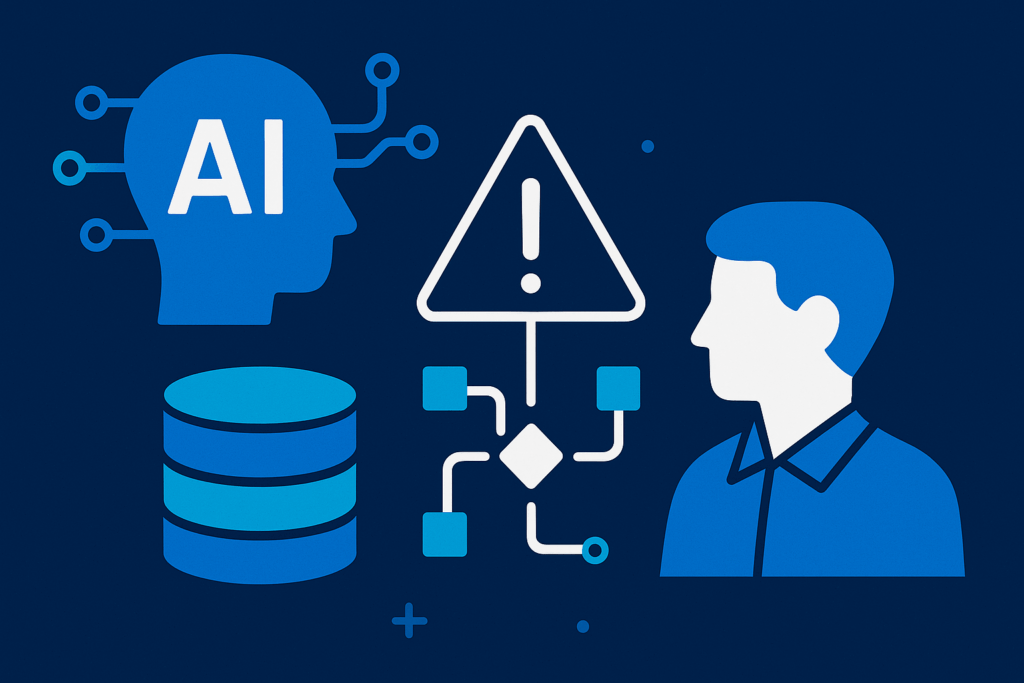
The brewing crisis: Why AI adoption could bury unprepared data teams
While everyone celebrates AI’s potential, a hidden crisis is unfolding across organizations. AI isn’t going to replace your data team—it will bury them under a mountain of chaos if you’re not prepared.
Here’s what’s happening right now in companies racing to adopt AI:
Business teams are launching AI initiatives with zero regard for governance or cost.
- Marketing wants a recommendation engine
- Sales needs predictive lead scoring
- Operations demands automated forecasting
- Each team spins up its own models, pulling data from wherever they can find it
- No centralized oversight, no standardization, no consideration for downstream consequences
The numbers tell the story: 72% of organizations have adopted AI in at least one business function, but only 26.4% of workers used generative AI at work in 2024—revealing a massive gap between organizational ambition and practical implementation.
Data platform bills are ballooning uncontrollably as models pull from everywhere.
- Snowflake or Databricks costs have doubled or tripled overnight
- Models query production tables directly, running expensive transformations on the fly
- Nobody knows who’s responsible for which workload
- Finance is demanding answers while engineering teams scramble to trace spending
Engineers are facing years of cleanup from undocumented pipelines and conflicting logic.
Six months into the AI boom, you discover:
- Three different definitions of “active customer” feed three different models
- Each produces conflicting predictions
- Original creators have moved on
- Documentation doesn’t exist
- Models are already in production
- Now it’s your problem to untangle
This brewing crisis isn’t hypothetical; it’s happening now at organizations of every size. The longer you wait to address it, the worse it gets. Organizations that don’t establish governance, standardization, and cost controls before the AI wave accelerates will spend the next three years fighting fires instead of innovating.
“It’s a shift from processes that are making data consumable by humans to making data, or the majority of data, consumable by machines. And that’s a vastly different process… The entire design pattern is different to do that successfully.”
The challenge isn’t the technology, it’s organizational readiness. Companies are struggling because AI capabilities are advancing faster than they can adapt their processes, culture, and teams to use them effectively.
The impact of AI on data engineering jobs won’t be about replacement—it will be about how engineers equip themselves to prevent the chaos versus which ones are drowning in it.
Why the shift matters
The transformation of AI in data engineering is profound. AI is being integrated across the entire data stack—from ingestion and ETL/ELT to orchestration, quality, and monitoring.
Erik Duffield describes the dramatic shift that we’ve moved from a world where 80% of data is served to human analysts through traditional BI tools to machines becoming the primary data consumers. This new world isn’t just a technical upgrade—it’s a complete reimagining of how data systems should be designed, optimized, and governed.
This fundamental shift changes everything:
From human consumption to machine consumption
- Data must be prepped, served, and governed for machines first, humans second
- Design patterns are fundamentally different—not just “lift and shift” to new technology
- The entire architecture needs to be rethought from the ground up
The stakes are rising
- Companies are ramping up AI and data infrastructure investments
- $107 billion deployed globally into AI startups in 2025, up 28% year-over-year
- Premium on reliable pipelines, high-quality data, and strong governance
- Data engineers who only maintain manual SQL and brittle pipelines risk becoming overwhelmed
The opportunity is clear
- Those who embrace AI-augmented workflows will find roles more strategic and in demand
- Engineers who prevent AI chaos will be indispensable
- The question isn’t whether to adopt AI—it’s whether you’ll do it strategically or reactively

The impact of AI on data engineering jobs
What’s changing
AI and data engineering are becoming inseparable. AI can be embedded at every stage of the data pipeline:
- Code generation and automated testing
- Self-healing observability systems
- Real-time anomaly detection
- Intelligent cost optimization
- Automated documentation and lineage
Organizations are eager to implement AI across their workflows—especially for code generation—but without proper structure and standards, they will multiply the problems teams face with legacy systems.
The role is expanding dramatically:
- From ETL specialist to architect of AI-ready infrastructure
- Managing model operations, data versioning, and feature stores
- Supporting AI workloads and machine learning pipelines
What’s not happening
AI isn’t replacing data engineers. Far from eliminating data engineering roles, AI is making them more valuable. The demand for skilled data engineers who can work alongside AI tools continues to surge. Engineers who combine technical expertise with data experience find themselves in a powerful position—organizations need professionals who can design the frameworks, validate AI outputs, and implement governance at scale. AI’s complementary impact far exceeds its substitution effect.
Humans remain essential for:
- Designing system architecture
- Validating AI-generated outputs
- Optimizing for cost and performance
- Integrating across complex environments
- Governing the chaos that unchecked AI creates
The engineers who thrive won’t write the most SQL—they’ll design the frameworks that let AI write SQL safely and sustainably.
What this means for your career
Now is the time to upskill into AI-capable roles.
- Focus on data for ML, governance frameworks, and model pipelines
- Master cost optimization and resource management
- Become an architect, strategist, and guardian of data trust
The numbers tell the story: By 2028, 60% of global companies will require employees to have basic AI skills.
If you don’t adapt, you’re likely to get left behind.
- Stuck maintaining outdated systems
- Fighting endless technical debt
- Cleaning up uncontrolled AI experiments
The future belongs to strategic engineers who:
- Understand both technical implementation AND strategic governance
- Build infrastructure, implement guardrails, enable innovation
- Balance velocity with stability

Key areas where AI will shake up data engineering
1. Pipeline generation and transformation logic automation
AI-powered assistants generate SQL, DAGs, or transformation logic in seconds.
Instead of manual coding:
- Prompt: “Give me the last 90-day churn by customer segment grouped by acquisition channel.”
- Get: Production-quality SQL as a starting point
- Result: Engineers focus on architecture, optimization, and governance—not boilerplate SQL
The velocity gain is dramatic: Developers using AI tools report 88% productivity increases, with teams delivering 3-5x faster while maintaining or improving quality standards.
| Real-world example: Coalesce Copilot |
|---|
Coalesce Copilot helps data engineers streamline development, governance, and collaboration. It’s like a senior teammate who knows your stack inside and out. It helps teams:
Key capabilities:
|
2. Data quality, observability, and self-healing pipelines
AI monitors pipelines in real time, detects anomalies, predicts failures, and suggests fixes.
This approach represents a fundamental shift:
- From: Reactive firefighting
- To: Proactive, predictive system design
Real-world scenario
3 AM on a Tuesday:
- Pipeline starts producing null values in a key revenue column
- AI-powered observability detects the anomaly within minutes
- System traces the issue to an upstream schema change in the source system
- Automatically alerts the on-call engineer with full context
- Suggests three remediation options
- All before business users notice anything wrong
The AI transformation:
- Engineers evolve from troubleshooting heroes to reliability architects
- Design self-healing systems that prevent cascading failures
- Move from fixing problems to preventing them
3. Metadata, lineage, documentation, and discoverability
AI auto-generates lineage, definitions, and descriptions for every data asset. Documentation is time-consuming, repetitive, and often doesn’t get done. Writing column descriptions and commit messages usually takes a back seat to shipping features. Over time, this trade-off inevitably creates problems: onboarding new team members slows down, handoffs get messy, and unclear transformation logic causes confusion across teams.
Real-world scenario
An analyst asks Slack: “What table should I use for active_user_count, and how is ‘active’ defined?”
Without AI:
- Wait hours for a data engineer’s response
- Risk of getting conflicting answers from different team members
- Dig through outdated wikis or Confluence pages
With an AI-powered data catalog:
- Surfaces the exact table instantly
- Shows complete lineage with every upstream dependency
- Displays transformation logic defining “active”
- Provides business-friendly descriptions
- Lists who to contact for questions
| Real-world example: Coalesce AI Documentation Assistant |
|---|
|
What it does:
The benefits:
The outcomes:
|
4. Data migrations, modernization, and AI-readiness
Many organizations remain stuck on legacy systems, hesitant to modernize despite knowing they need to. The concerns are valid: migrations have historically been notorious for blown budgets, extended timelines, and the risk of downtime. But as data leaders are discovering, clinging to outdated infrastructure comes with its own costs—legacy systems simply weren’t built for the AI era and can’t scale to support modern machine learning workloads.
| Why companies remain hesitant | |
|---|---|
Common concerns:
|
The reality:
|
Here’s where AI fundamentally changes the equation. AI tools can now parse legacy logic, translate code, and rebuild pipelines for cloud environments.
“The emergence of AI has transformed the reality of data migrations almost overnight. Modern LLMs are adept at parsing XML, YAML, JSON, and SQL—and translating seamlessly between them. It’s no exaggeration to say that today you can hand over nearly 80% of a migration project to AI, dramatically reducing both timelines and cost.”
| Before AI | With AI (80% Automation) |
|---|---|
| Manually write parsers for every format | Parse XML, YAML, JSON, and SQL automatically |
| Translate thousands of lines of code by hand | Translate between formats in minutes |
| Months of labor-intensive work | Validate data parity automatically |
| High risk of errors | Dramatically reduced timelines and costs |
What historically took 12-18 months of manual work now completes in 6-8 weeks—and with better outcomes than traditional “lift and shift” approaches.
| Avoiding “lift and shift” migrations to focus on strategic modernization with AI | |
|---|---|
|
|
AI doesn’t just make migrations faster; it makes them smarter by enabling teams to rebuild on sustainable, standardized frameworks rather than dragging technical debt to the cloud. Engineers will become modernization leaders who enable AI-ready infrastructure instead of just maintaining legacy systems.
“With AI taking a huge percentage of a migration’s manual grunt work off your plate, the real challenge that remains isn’t moving data—it’s building the right framework for the AI era. Too many teams migrate their entire environment, dragging inefficiencies and bad architecture along with them.”
5. Business-aware optimization and cost control
AI understands business priorities and optimizes pipelines accordingly. This is where AI for data engineering jobs becomes truly strategic. This capability elevates data engineers from being perceived as “the team that keeps systems running” to strategic business partners who drive measurable outcomes.
When you can demonstrate that your AI-optimized pipelines saved 30-40% on infrastructure costs while improving data freshness for revenue-critical models, you’re no longer having conversations about technical debt—you’re presenting at quarterly business reviews. Engineers who leverage AI for business-aware optimization gain visibility with executives, influence product and strategy decisions, and position themselves as essential to competitive advantage. It’s the difference between being a cost center and being recognized as a profit enabler.
Real-world scenario
AI optimization system in action:
- Understands that real-time customer behavior data drives the most valuable ML models
- Must refresh every 15 minutes regardless of cost (business-critical)
- Historical trend analysis for quarterly planning can be refreshed weekly during off-peak hours
- Automatically prioritizes compute resources
- Balances business value against infrastructure spending
- Result: 30-40% cost savings without sacrificing critical capabilities
This alignment between business goals and technical execution:
- Prevents runaway costs from uncontrolled AI adoption
- Positions data engineers as strategic business partners
- Demonstrates understanding of ROI, not just uptime
- Transforms perception from “backend infrastructure” to “business enabler”
Getting ahead of the AI crisis: How data engineers can work smarter with AI today
The good news? You can prevent the AI crisis before it buries your team. Unlike previous technology shifts that caught organizations off guard, the warning signs of AI-driven chaos are visible right now—which means proactive data teams have a narrow but crucial window to get ahead of the problems.
The teams that will thrive aren’t necessarily those with the most resources or the largest budgets; they’re the ones that act decisively today to establish governance, standardize workflows, and implement guardrails before AI adoption accelerates beyond their ability to control it.
The strategies below aren’t theoretical best practices for some distant future—they’re practical actions you can start implementing this week to ensure your team becomes a strategic enabler of AI initiatives rather than getting buried under the weight of uncontrolled experimentation.
1. Implement proactive governance and guardrails
Data governance is no longer a control mechanism; it’s an enablement mechanism. Establishing robust governance policies today allows you to position your data foundation for success BEFORE the incoming AI crisis hits.
Define the rules:
- Who can create models?
- Where can they source data?
- What cost thresholds trigger alerts?
- What approval processes are required for production?
The mindset shift: Governance as enabler, not bottleneck. Organizations must consider “what does an enabling data governance process look like along our entire data value chain?” By implementing guardrails, you can enable rapid innovation without sacrificing control.
Security is paramount: Coalesce CTO Satish Jayanthi emphasizes in a recent article, “When it comes to AI, security should never be put on the back burner. As tempting as it may be to introduce more data sets to train models, sensitive data should never be used for this purpose.”
Practical steps to take:
- Create a clear taxonomy for data assets (raw, curated, production-ready)
- Establish and enforce naming conventions through automation
- Set up cost monitoring with automatic alerts at defined thresholds
- Implement approval workflows for production model deployments
- Document ownership and accountability for every data asset
2. Rigorously standardize data pipelines and logic
Use AI to accelerate—but enforce standards ruthlessly. The key word is “enforce”—not suggest, not recommend, not hope for compliance. This means implementing automated checks that reject AI-generated code that doesn’t follow naming conventions, requiring documentation before any asset can be promoted to production, establishing templates that structure how teams should prompt AI tools, and creating approval workflows that catch violations before they compound. Without enforcement mechanisms, good intentions evaporate under deadline pressure.
“Everyone today is scrambling to use AI for everything, including code generation, but if your approach is not structured and standardized, you risk compounding the problems with your previous system. Why not leverage AI to accelerate your migration to a more modern platform and nip tech debt in the bud today—not two years down the road?”
Prevent tech debt accumulation today rather than fighting chaos 18 months from now when you’ve accumulated thousands of undocumented AI-generated assets. The teams that succeed with AI-accelerated development share a common pattern: they treat standardization as non-negotiable infrastructure, not optional overhead.
Build frameworks where AI-generated code automatically inherits proper structure, where documentation is generated alongside the asset rather than as an afterthought, and where governance rules are encoded into the development process itself. Teams taking this approach can experience AI’s velocity benefits without the subsequent chaos because they’ve engineered standardization into the workflow from day one. The alternative—trying to retrofit standards onto thousands of existing undocumented assets—is exponentially more expensive and often never fully succeeds.
Using platforms like Coalesce, teams can build:
- Standardized, metadata-driven transformations
- Modular, reusable components
- Designs for automation and scalability
- Systems maintainable by anyone—not just the original creator
3. Separate experimental changes from production environments
Allow innovation—enforce compartmentalization. This is the essential tension data teams must resolve: business teams need freedom to experiment with AI and iterate quickly, but you can’t let that experimentation contaminate production systems or spiral into uncontrolled costs. The solution isn’t to lock everything down with approval processes that kill innovation; it’s to create clear boundaries that enable rapid experimentation within safe containers.
Compartmentalization means establishing dedicated sandboxes where teams can freely experiment with AI models, test new approaches, and fail fast without touching production data or racking up uncapped cloud costs.
In this scenario, marketing can spin up experimental customer segmentation models, data scientists can prototype new ML features, and product teams can test analytical hypotheses—all without risk of corrupting trusted datasets, breaking production pipelines, or surprising finance with six-figure cloud bills.
But there must be clear, enforced criteria for what’s allowed to graduate from sandbox to production. Not every experiment should make it to production, and the ones that do must meet governance standards, pass quality checks, and operate within resource guardrails.
“Lower the cost of failure—if you can do those ten experiments faster and cheaper than everyone’s doing one, you’ve lowered your cost of failure. You’re now an effective experimenting organization. If you’re an experimenting organization [that takes] six months to get something approved… everyone chokes the living life out of the thing because they’re paranoid of failure, you’re gonna drive failure and you’re never gonna get a new one.”
Practical implementation:
- Set up separate dev, staging, and production environments
- Allocate fixed compute budgets for experimentation
- Require governance review before promoting to production
- Use feature flags to control rollout of AI-powered features
- Result: Business agility without sacrificing core stability
4. Embed AI-driven observability tools
Detect problems before they cause downstream issues. Modern AI-powered observability goes far beyond traditional monitoring. These systems don’t just track whether pipelines succeeded or failed; they analyze data profiles, detect anomalies in distributions, identify schema drift before it breaks downstream dependencies, predict resource exhaustion before queries time out, flag unusual data volumes that might indicate upstream problems, and correlate issues across your entire data ecosystem to surface root causes automatically.
When a source system introduces a new null-handling pattern, AI observability catches it immediately and traces potential downstream impacts. When data freshness degrades, it identifies the bottleneck and suggests optimizations. When costs spike unexpectedly, it pinpoints which queries or processes are responsible.
These tools help you shift from reactive firefighting to proactive system design. Instead of spending 60% of your time troubleshooting, you spend 60% of your time improving architecture because problems are caught and resolved before they cascade. The impact on team morale is dramatic—chronic firefighting burns out engineers, while proactive system design where you stay ahead of problems is energizing and sustainable.
Practical implementation:
- Monitor for schema changes
- Identify anomalies and data drift
- Alert before business users notice
- Provide full context for faster resolution
5. Automate documentation and lineage tracking
Use AI to make data assets searchable, documented, and governed by default. The traditional approach to documentation collapses when AI accelerates development from hours to minutes. If generating a transformation takes 5 minutes but documenting it takes 30, documentation becomes a 6x tax that teams inevitably skip under deadline pressure. The predictable result: hundreds of undocumented assets accumulating faster than anyone can catalog them.
AI-powered documentation tools solve this by making governance automatic—analyzing transformation logic as it’s created, generating natural-language descriptions, creating lineage documentation, and enriching metadata simultaneously with development. Documentation scales with velocity rather than becoming a bottleneck.
The result? Every asset created—whether by humans or AI—is immediately discoverable, understandable, and trustworthy. Business analysts find tables with clear descriptions and complete lineage. New engineers explore self-documenting systems rather than reverse-engineering tribal knowledge. Auditors see comprehensive governance without manual scrambling. This automated approach prevents the chaos that buries unprepared teams: when AI enables creating 200 assets per month instead of 20, only automated documentation can maintain discoverability and trust at scale.
Real-world examples:
- Coalesce AI Documentation Assistant: Automatically document transformation pipelines without slowing down your work. Auto-generates descriptions, commit messages, metadata.
- Coalesce Catalog: Manage and govern data assets with our AI-powered data catalog that embeds rich, collaborative documentation and governance standards into your development environment.
6. Leverage AI for data migrations
Translate legacy logic, rebuild pipelines, validate transformations—all automatically. AI has eliminated the primary excuse organizations use to delay modernization: the massive manual effort traditionally required. What used to demand teams of offshore developers spending months hand-translating COBOL or Informatica XML into modern SQL can now be largely automated.
AI tools parse legacy formats, understand business logic embedded in decades-old code, translate to modern cloud-native patterns, generate comprehensive test suites to validate parity, and document everything according to current governance standards—all in a fraction of the time manual approaches required.
Don’t let outdated systems hold you back. Use AI to accelerate modernization to platforms built for the AI era. Every month you remain on legacy infrastructure isn’t neutral—it’s actively costing you:
- Your competitors are building on platforms that support real-time ML
- Your team is maintaining systems that require increasingly rare (and expensive) specialist skills
- Your cloud platform is underutilized because legacy tools can’t leverage its capabilities
- AI initiatives get blocked by infrastructure that wasn’t designed for machine learning workloads
The opportunity cost of delay is enormous: not just the direct costs of legacy maintenance, but all the innovations you can’t pursue, all the efficiencies you can’t realize, and all the competitive advantages you’re ceding to faster-moving rivals.
Practical implementation:
- Parse legacy logic automatically
- Translate to modern patterns
- Validate data parity
- Document per governance standards
- Result: 12-18 month migrations complete in weeks
7. Upskill for the AI era
Learn the skills that matter. The engineers who will thrive in the AI era aren’t necessarily those who understand AI’s underlying algorithms—they’re the ones who know how to work effectively alongside AI tools to amplify their impact.
Core skills for AI-enabled data engineers:
- Prompt engineering for AI copilots and code generation
- MLOps and model governance frameworks
- Metadata management and data cataloging
- Cost optimization and resource allocation strategies
- Governance frameworks and policy enforcement
- Testing and validation for AI-generated code
“Use AI on a regular basis in your normal, daily work. Every tool will soon have AI embedded into it, so understanding the technology is critical. Get familiar with AI in your personal life by using it to make travel plans, write emails, and automate other minor daily tasks.”
Build intuition through practice. As Jayanthi advises, the key to developing AI fluency is daily hands-on use rather than abstract study. Start integrating AI into mundane tasks: use it to draft emails, plan complex schedules, summarize meeting notes, or generate initial code that you then refine. Every interaction teaches you something about how these tools think, where they excel, and where they struggle.
When you use AI like a personal assistant and teacher, your experience, understanding, and insight into its workings—not to mention its limitations—will expand. You’ll start recognizing patterns: AI is excellent at boilerplate and structure but needs human guidance on business logic and edge cases. It can generate code quickly but requires validation to ensure correctness and optimization. It excels at consistency but struggles with context that isn’t explicitly provided.
This intuitive understanding—built through hundreds of small interactions—becomes invaluable when architecting systems that leverage AI effectively. You’ll know instinctively where to apply AI for maximum benefit and where human expertise remains essential, making you far more effective than engineers who either avoid AI entirely or blindly trust its outputs.
Final thoughts: Collaboration, not competition
The rise of AI in data engineering isn’t about replacement—it’s about reinvention. Engineers who embrace AI will automate repetitive work, scale their impact exponentially, and become strategic enablers of enterprise AI initiatives. You’ll shift from maintaining pipelines to architecting intelligent, self-governing systems that empower entire organizations.
As Erik Duffield emphasizes, “This will make data more important. Data’s moving faster. It’s more impactful. It’s getting more decisions allocated to it. And so the people that shepherd it, that design it, that architect it, that test it, that validate it, it’s great careers for them.”
The numbers support this optimism:
- By 2025, AI is projected to require hiring 97 million people globally
- The AI-driven job market is expected to grow 38% annually from 2024 to 2030
Those who resist risk getting buried under mounting tech debt, chaotic data sprawl, and runaway costs. The crisis is real—but it’s preventable for those who act strategically now rather than reactively later.
Platforms like Coalesce show what the next generation of AI-powered data engineering looks like: governed, automated, explainable, and fast. AI isn’t bolted on as an afterthought—it’s embedded natively into transformation, documentation, migration, and discovery.
The companies that will dominate the AI era aren’t those with the most data or the biggest teams—they’re the ones that build sustainable frameworks for managing AI-accelerated development. They establish governance before chaos. They standardize before sprawl. They invest in platforms designed for the future.
The future belongs to those who see AI not as competition—but as collaboration. So, the question isn’t whether AI will replace data engineers. It’s whether you’ll harness AI to elevate your craft—or get buried by those who do.
Frequently Asked Questions about AI in Data Engineering
No, data engineering will not be replaced by AI. While AI can automate tasks like code generation and documentation, data engineers remain essential for designing system architecture, validating AI outputs, implementing governance frameworks, and managing complex integrations. The role is evolving rather than disappearing—data engineers who embrace AI tools and focus on strategic work like governance, optimization, and AI-ready infrastructure will find themselves more valuable than ever.
AI transforms data engineering jobs by automating repetitive tasks while creating demand for higher-level strategic work. Studies show AI’s complementary impact significantly outweighs its substitution effect. Data engineers are now expected to manage AI workloads, implement model governance, optimize for cost, and architect systems that serve both human and machine consumers. The impact is expanding responsibilities rather than eliminating roles, with 76% of data work now enhanced by AI tools that enable 25% productivity improvements.
Data engineers can leverage AI in several practical ways: use AI copilots to generate SQL and transformation logic faster, embed AI-driven observability tools to detect issues before they impact users, automate documentation and lineage tracking to maintain governance at scale, use AI for data migrations to accelerate legacy modernization projects, and implement AI-powered cost optimization to balance business priorities with infrastructure spending. The key is using AI to eliminate repetitive work while focusing human expertise on architecture, validation, and strategic decision-making.
Agentic AI data engineering refers to using autonomous AI agents that can independently perform data engineering tasks like monitoring pipelines, detecting anomalies, suggesting fixes, and executing remediation actions with minimal human intervention. These AI agents operate within defined guardrails and workflows to handle routine operations, allowing data engineers to focus on strategic initiatives. While evolving, agentic AI is already deployed for self-healing pipelines, automated testing, and intelligent workflow orchestration.
AI-enabled data engineers need a combination of technical and strategic skills: prompt engineering for working with AI copilots, MLOps, and model governance frameworks, metadata management and data cataloging, cost optimization and resource allocation strategies, governance policy development and enforcement, and testing/validation methodologies for AI-generated code. By 2030, AI will require workers to change 70% of the skills used in most jobs, making continuous upskilling essential. Strategic thinking, leadership, and balancing innovation with governance are increasingly valuable alongside technical capabilities.
AI dramatically improves data engineering productivity across multiple dimensions. Developers using AI tools report 88% productivity increases, with teams delivering 3-5x faster while maintaining quality. AI automates time-consuming tasks like writing boilerplate SQL, generating documentation, and validating data quality. It reduces pipeline development time from hours to minutes and enables engineers to focus on architecture and optimization rather than repetitive coding. Studies show AI can impact 76% of data engineering work, allowing 25% improvement in achievable productivity.
AI and data engineering work together to create a collaborative relationship where AI handles repetitive, automatable tasks while humans provide strategic oversight, validation, and governance. AI excels at generating code, monitoring systems, and processing patterns, but struggles with context, business logic, and complex decision-making that requires human judgment. Data engineers who work with AI can deliver 10x more value by focusing on system design, governance frameworks, and strategic optimization. In contrast, replacing data engineers with AI would result in ungoverned chaos, runaway costs, and technical debt—AI still requires human expertise to validate outputs, implement guardrails, and ensure systems align with business objectives.